This study aimed to develop IDF models and compare rainfall intensity obtained from the stationary and non-stationary IDF models for Umuahia in South-Eastern Nigeria. The research used a long-term rainfall dataset spanning three decades (1992-2022) sourced from the Nigerian Meteorological Agency. The daily rainfall data recorded over 24 hours was downscaled to shorter periods using the Indian Meteorological Department model (IMD). For determining the best distribution fitting for the rainfall data, the Kolmogorov-Smirnov (K-S) test was utilised. The result from the K-S test revealed that Gumbel EVT-1 was the best-fitting distribution for creating the stationary IDF models. The GEVt-I model, which includes a time-dependent location parameter, proved the most effective for non-stationary models. The comparative analysis showed that non-stationary models forecasted greater rainfall intensities for shorter return periods (2-10 years), with variations between 4.93 and 16.16% for the 2-year return period. In contrast, for longer return periods (25-100 years), stationary models yielded higher intensity predictions, with differences ranging from -0.29 -13.21%. These results have important implications for infrastructure design and flood risk management in Umuahia, indicating that existing drainage systems based on stationary assumptions may be undersized by 5-16%, which could elevate the risk of flooding during typical rainfall events.
This is an Open Access article, distributed under the terms of the Creative Commons Attribution 4.0 International License (http://creativecommons.org/licenses/by/4.0/), which permits unrestricted use, distribution and reproduction in any medium or format, provided the original work is properly cited.
Rainfall Intensity-Duration-Frequency (IDF), Non-stationary Modelling, Stationary Modelling, Climate Change, General Extreme Value (GEV) Distribution
1. Introduction
Climate change has emerged as a major global issue, significantly impacting hydrological systems across the globe. In Nigeria, signs of changing climate are becoming clearer as research has shown that the temperature and rainfall patterns have been changing over the years
[13]
Odjugo, P. A. O. (2013). Analysis of climate change awareness in Nigeria. Science Research Essays, 8(26), 1203-1211.
[3]
Akinsanola, A. A. & Ogunjobi, K. O. (2015). Recent homogeneity analysis and long-term spatio-temporal rainfall trends in Nigeria. Theoretical and Applied Climatology, 128, 275-289.
[16]
Sam, M. G., Nwaogazie, I. L., Ikebude, C., Inyang, U. J. and Irokwe, J. O. (2023a). Modeling Rainfall Intensity-Duration-Frequency (IDF) and Establishing Climate Change Existence in Uyo-Nigeria Using Non-Stationary Approach. Journal of water Resource and protection, Vol. 15, pp 194-214.
[7]
Ekwueme, C. M., Nwaogazie, I. L., Ikebude, C. F., Amuchi, G. O., Irokwe, J. O., et al. (2025). Modeling Rainfall Intensity-Duration-Frequency (IDF) and Establishing Climate Change Existence in Umuahia - Nigeria Using Non-Stationary Approach. Hydrology, 13(1), 83-89.
. These shifts pose significant challenges to conventional hydrological design methods that depend on the principle of stationarity, where the belief is that past rainfall parameters will remain unchanged moving forward.
Climate change significantly affects the approach adopted for developing rainfall models, which are crucial for designing and managing water infrastructure. Drainage networks, culverts, dams, and bridges are typically designed using Intensity-Duration-Frequency (IDF) relationships, which reflect the statistical features of severe rainfall occurrences. Traditionally, IDF models have been developed under the assumption of stationarity, which presumes that the statistical characteristics of rainfall patterns remain constant over time. However, this assumption has been increasingly questioned as climate change alters precipitation patterns globally
[11]
Milly, P. C. D., Betancourt, J., Falkenmark, M., Hirsch, R. M., Kundzewicz, Z. W., Lettenmaier, D. P. & Stouffer, R. J. (2008). Stationarity is dead: Whither water management? Science, 319(5863), 573-574.
AghaKouchak, A., Ragno, E., Love, C. & Moftakhari, H. (2018). Projected Changes in California's precipitation intensity-duration-frequency curves. California's fourth climate change assessment, California energy commission. Pub. No.: CCCA4-CEC- 2018-005.
[18]
Sam, M. G., Nwaogazie, I. L., & Ikebude, C. (2023c). General extreme value fitted rainfall non-stationary intensity-duration-frequency (NS-IDF) modelling for establishing climate change in Benin City. Hydrology, 11(4), 85-93.
[11, 2, 18]
. In the South-Eastern region of Nigeria, significant changes in rainfall patterns have been observed over recent decades
[7]
Ekwueme, C. M., Nwaogazie, I. L., Ikebude, C. F., Amuchi, G. O., Irokwe, J. O., et al. (2025). Modeling Rainfall Intensity-Duration-Frequency (IDF) and Establishing Climate Change Existence in Umuahia - Nigeria Using Non-Stationary Approach. Hydrology, 13(1), 83-89.
. Akinsanola & Ogunjobi, indicated a rising trend in annual rainfall of 15.4% and 13.9% for annual and seasonal rainfall, respectively, at various stations in Nigeria
[3]
Akinsanola, A. A. & Ogunjobi, K. O. (2015). Recent homogeneity analysis and long-term spatio-temporal rainfall trends in Nigeria. Theoretical and Applied Climatology, 128, 275-289.
[3]
. These findings suggest that traditional stationary IDF models may no longer adequately represent the evolving rainfall patterns in the region.
Non-stationary IDF modeling techniques account for temporal variations in rainfall characteristics, which the conventional stationary methods do not. By integrating time as a covariate in the statistical distribution parameters, non-stationary models may effectively reflect the changing precipitation patterns in a shifting climate
[4]
Cheng, L. & AghaKouchak, A. (2014). Non-stationarity precipitation intensity-duration-frequency curves for infrastructure design in a changing climate. Science Reports, 4(7093), 1-6.
[5]
Cheng, L., AghaKouchak, A., Gilleland, E. & Katz, R. W. (2014). Non-stationary extreme value analysis in a changing climate. Climate Change, 127(2), 353-369.
[8]
Ganguli, P. & Coulibaly, P. (2017). Does non-stationarity in rainfall require non-stationary intensity-duration-frequency curves? Hydrology and Earth System Sciences, 21, 6461-6483.
[14]
Ouarda, T. B. M. J., Yousef, L. A. & Charron, C. (2019). Non-stationary intensity-duration-frequency curves integrating information concerning teleconnections and climate change. International Journal of Climatology, 39, 2306-2323.
. Ouarda et al. demonstrated that non-stationary frameworks for IDF modeling better fit for rainfall data than stationary methods, especially for rainfall data with a trend
[14]
Ouarda, T. B. M. J., Yousef, L. A. & Charron, C. (2019). Non-stationary intensity-duration-frequency curves integrating information concerning teleconnections and climate change. International Journal of Climatology, 39, 2306-2323.
. Understanding the quantitative differences between stationary and non-stationary IDF models is important in effective infrastructure planning and managing flood risks. Infrastructure built with underestimated rainfall intensities may struggle to cope with actual precipitation events, heightening flood risks and increasing the chances of structural failures
[5]
Cheng, L., AghaKouchak, A., Gilleland, E. & Katz, R. W. (2014). Non-stationary extreme value analysis in a changing climate. Climate Change, 127(2), 353-369.
[1]
Abiodun, B. J., Adegoke, J., Abatan, A. A., Ibe, C. A., Egbebiyi, T. S., Engelbrecht, F. & Pinto, I. (2017). Potential impacts of climate change on extreme precipitation over four African coastal cities. Climate change (2017) 143: 399-413.
. This is particularly crucial for emerging regions like South-Eastern Nigeria, where urbanisation is rising
[10]
Masi, M., Kanakoudis, V., & Salcedo, A. G. (2023). Statistical, Analytical and Numerical Approaches for the Design of Urban Drainage Systems under Climate Change Conditions. Climate, 11(7), 141.
. This study aims to develop IDF models and compare rainfall intensity obtained from the stationary and non-stationary IDF models for Umuahia in South-Eastern Nigeria.
2. Materials and Methods
2.1. Study Area
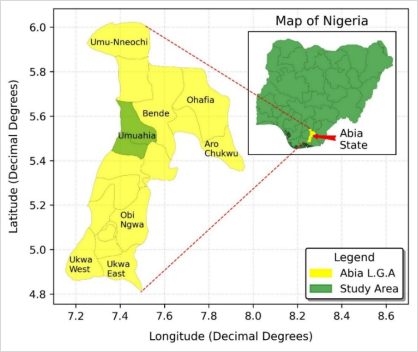
Umuahia, the capital of Abia State, is in southeastern Nigeria in the Niger Delta region, at coordinates 5.5544°N latitude and 5.7932°E longitude (Figure 1). This city has a tropical climate, marked by a rainy season from April through October and a dry season from November to March. Its climate is shaped by its proximity to the Atlantic Ocean and its position within the Guinea Forest-Savanna mosaic ecoregion. The region generally receives heavy annual rainfall, which makes it prone to flooding and other rain-related issues. In recent years, rapid urban development has increased Umuahia's vulnerability to climate change, especially regarding shifts in rainfall patterns.
The research employed a long-term rainfall dataset covering approximately three decades. A 31-year record from 1992 to 2022 was sourced from the Nigerian Meteorological Agency (NIMET) specifically for Umuahia. This dataset consisted of 24-hour daily rainfall measurements of the entire study, taken when it rained in Umuahia. Statistical methods were utilised to obtain each year's annual 24-hour maximum rainfall. To derive shorter rainfall duration records, the 24-hour data were downscaled using the Indian Meteorological Department (IMD) model, as outlined in Equation (1)
[15]
Sam M. G, Nwaogazie I. L. and Ikebude, C. (2021): Improving Indian meteorological department method for 24- hourly rainfall downscaling to shorter durations for IDF modelling. International Journal of Hydrology; 5(2): 72-82.
. The shorter duration records included 5, 10, 20, 30, 60, 120, 360, and 720 minutes.
=(1)
Where = Downscaled rainfall precipitation, = daily rainfall precipitation (mm), t = time.
2.3. Development of Stationary and Non-Stationary IDF Rainfall Models
The magnitude of the extreme rainfall was computed using stationary and non-stationary approaches. Stationary approaches assume that the statistical parameters of the rainfall data remain constant over time, while non-stationary approaches assume that the statistical parameters vary over time. The magnitude of the extreme rainfall under stationarity was computed using Frequency Analysis
[20]
Te Chow, V., Maidment, D. R., & Mays, L. W. (1988). Solutions Manual to Accompany Applied Hydrology. McGraw-Hill.
[20]
. Equation (2) was utilised to compute the magnitude of the extreme rainfall.
XT=+ KTS (2)
Where XT = magnitude of the rainfall under a given time and return period, = mean of the rainfall at a particular time, S = standard deviation at a particular time, KT = Frequency factor.
The frequency factor varies depending on the probability distribution. Table 1 gives the equations of frequency factors for three major probability distributions used for computing the magnitude of hydrologic events. Nwaogazie et al. detailed how frequency factors are used to obtain the magnitude of rainfall for five probability distributions
[12]
Nwaogazie, I. L., Sam, M. G., Enciso, R. Z., & Gonsalves, E. (2019). Probability and non-probability rainfall intensity-duration-frequency modeling for Port-Harcourt metropolis, Nigeria. International Journal of Hydrology, 3(1), 66-75.
[12]
. The selection of the Frequency factor to utilise depends on how best the historical rainfall data fit the distribution. Kolmogorov Smirnov test was utilised to establish which distribution out of the four distributions considered, namely Gumbel EVT-1, Normal, Pearson Type -III, and Log Normal, fit the rainfall data best. Kolmogorov Smirnov test compares the cumulative distribution function of the rainfall data against the theoretical distribution function. The null hypothesis states that the dataset comes from a particular distribution been tested. If the computed D is greater than the critical value of the Kolmogorov-Smirnov statistic, then one rejects the null and states that the rainfall dataset does not come from that distribution. The best distribution with the less D value confirms that the rainfall dataset best fits that distribution, and the corresponding frequency factor would be utilised in obtaining the magnitude of the extreme rainfall (Equation (3)).
D =max|FO(x) –Ft(x)| (3)
Table 1. Frequency factor for three probability distribution.
Distribution
Frequency Factors (KT)
Gumbel EVT-1
KT = where T= return period
Normal
-
w = for (0 < p ≤ 0.5) where p = 1/T
if p > 0.5, p is replaced with 1 – p
W =
Pearson
KT = Z + (Z2 - 1) K + 1/3 (Z3 -6) K2 –(Z2 -1) K3 +ZK4 + 1/3 K5K= when Cs ≠ 0 where Cs = coefficient of skewness
Source:
[20]
Te Chow, V., Maidment, D. R., & Mays, L. W. (1988). Solutions Manual to Accompany Applied Hydrology. McGraw-Hill.
[20]
The confirmation of non-stationarity in rainfall data is done using Mann Kendall which establish that there is a significant trend in the data
[17]
Sam, M. G., Nwaogazie, I. L., & Ikebude, C. (2023b). Establishing Climatic Change on Rainfall Trend, Variation and Change Point Pattern in Benin City, Nigeria. International Journal of Environment and Climate Change, 13(5), 202-212.
[17]
. Ekwueme et al. analysed the trend in rainfall data from 1992 to 2022 for Umuahia and confirmed the existence of an increasing trend in the rainfall for Umuahia
[7]
Ekwueme, C. M., Nwaogazie, I. L., Ikebude, C. F., Amuchi, G. O., Irokwe, J. O., et al. (2025). Modeling Rainfall Intensity-Duration-Frequency (IDF) and Establishing Climate Change Existence in Umuahia - Nigeria Using Non-Stationary Approach. Hydrology, 13(1), 83-89.
. The non-stationary IDF rainfall models were developed using the General Extreme Value (GEV) distribution
[18]
Sam, M. G., Nwaogazie, I. L., & Ikebude, C. (2023c). General extreme value fitted rainfall non-stationary intensity-duration-frequency (NS-IDF) modelling for establishing climate change in Benin City. Hydrology, 11(4), 85-93.
[18]
. This distribution was specifically adapted to model various behavioural extremes through three parameters namely: location, scale, and shape
[5]
Cheng, L., AghaKouchak, A., Gilleland, E. & Katz, R. W. (2014). Non-stationary extreme value analysis in a changing climate. Climate Change, 127(2), 353-369.
[5]
. Equation (4) illustrates the GEV's standard cumulative distribution function (CDF) as provided by
[6]
Coles, S., Bawa, J., Trenner, L. & Dorazio, P. (2001). An introduction to statistical modeling of extreme values. London: Springer.
[6]
.
(4)
Where F(x) = Cumulative distribution function, = mean (location), = standard deviation (scale) and, = shape parameter are three behavioural parameter extremes.
The maximum likelihood estimator served as the statistical method for estimating distribution parameters due to its ability to adapt to non-stationary evaluations. Non-stationarity arises when one or more GEV statistical parameters are expressed as time functions
[6]
Coles, S., Bawa, J., Trenner, L. & Dorazio, P. (2001). An introduction to statistical modeling of extreme values. London: Springer.
[9]
Katz, R. W. (2013). Statistical methods for nonstationary extremes. In: Extremes in a changing climate (pp. 15-37). Dordrecht: Springer.
[6, 9]
. Three linear expressions of non-stationarity were employed to develop the IDF models, as detailed in Table 2. The best non-stationary model was chosen based on AIC and BIC goodness of fit criteria. The model with the lowest AIC and BIC best fit the rainfall's non-stationarity was deemed to adequately model the non-stationarity pattern in the rainfall data. Library (extRemes) in R-studio was used to derive the non-stationary model parameters and to calculate rainfall intensity.
Table 2. Types of Selected GEV Linear Parameter Models.
Model Type
Parameter Combination
Remark
(i) GEVt – 0
Stationary parameter model
(ii) GEVt – I
Non-stationary parameter model
(iii) GEVt – II
Non-stationary parameter model
(iv) GEVt – III
Non-stationary parameter model
Source:
[19]
Silva, D. F. & Simonovic, S. P. (2020). Development of non-stationary rainfall intensity duration frequency curves for future climate conditions. Water resources research report No: 106. Department of civil and environmental engineering, western University, Canada.
[19]
2.4. Comparative Analysis of Rainfall Intensity
Rainfall intensities were computed for various durations (5-1440 minutes) and return periods (2, 5, 10, 25, 50, and 100 years) to quantify differences between stationary and non-stationary approaches using both modelling approaches. Percentage differences were calculated using Equation (5):
Percentage diff (%) =(5)
Where NS = rainfall intensity from non-stationary model, S = rainfall intensity from stationary model.
3. Results
3.1. Stationary IDF Model Development
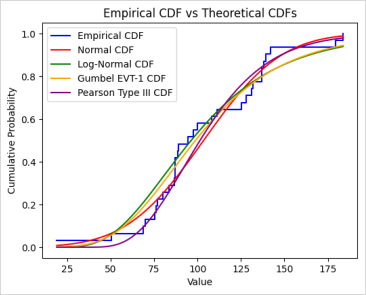
Visual inspection of the cumulative distribution function presented in Figure 2 revealed that the four theoretical cumulative distribution functions fit relatively well with the empirical cumulative distribution function. However, Gumbel EVT-1 (yellow line) was revealed to be the best fit as the maximum difference between the empirical and Gumbel EVT-1 CDF was relatively smaller than other theoretical CDFs. This was confirmed by the Kolmogorov-Smirnov test, as presented in Table 3. The result from Table 3 revealed that the maximum difference for the empirical CDF and Gumbel EVT-1 theoretical CDF was 0.09537 which was less than the critical value of 0.2443 at 5% significance level. The evidence provided by the K-S test informed the decision to develop the rainfall IDF model using Gumbel EVT-1 distribution. This finding aligns with hydrological theory, as the Gumbel distribution is widely recognised for its effectiveness in modelling extreme events such as annual maximum rainfall. Gumbel's superior performance compared to other distributions is likely due to its ability to capture the right-skewed nature of rainfall extremes in Umuahia's tropical climate.
Based on the selected Gumbel distribution, stationary IDF curves were developed for various durations and return periods. The KT factor was computed for five return periods, and the rainfall intensities were computed for various durations and return periods, as presented in Table 4. Figure 3a presents the stationary IDF curves for shorter durations (5-60 minutes), which can be utilised to design urban culverts and drainage. Figure 3b shows IDF curves for longer durations (120-1440 minutes), which can be utilised for the design of bridges. The rainfall IDF curves exhibit the characteristic hyperbolic relationship between rainfall intensity and duration, with intensity decreasing as duration increases. Higher curves correspond to longer return periods, reflecting the increased rainfall intensity expected for less frequent events.
Figure 2. Empirical and theoretical Cumulative Distribution function.
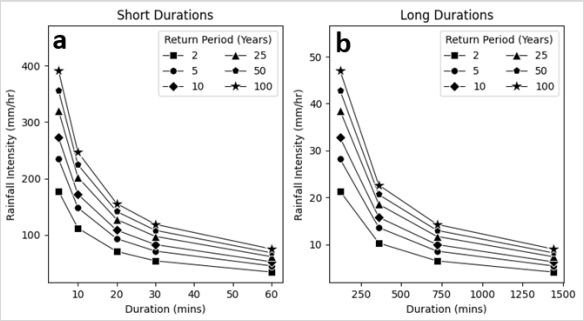
Table 3. Kolmogorov-Smirnov Test Results for Distribution Fitting for Umuahia.
Time (mins)
Gumbel EVT-1
Normal
Log-Normal
Pearson Type III
Best Distribution Fit
5
0.09531
0.13975
0.11675
0.12762
Gumbel
10
0.09537
0.13983
0.11701
0.12997
Gumbel
20
0.09513
0.13998
0.11642
0.13051
Gumbel
30
0.09524
0.14012
0.11671
0.13121
Gumbel
60
0.09515
0.14010
0.11657
0.13045
Gumbel
120
0.09531
0.14002
0.11649
0.13043
Gumbel
360
0.09525
0.14001
0.11661
0.13100
Gumbel
720
0.09525
0.13994
0.11668
0.13116
Gumbel
1440
0.09525
0.13997
0.11661
0.13154
Gumbel
Critical value = 0.24426, = 0.05. Bold values indicate that it was significant, while values highlighted with red indicate that the data best fit that distribution.
Table 4. Computed rainfall intensity using Gumbel Distribution.
Figure 3. Stationary IDF Curves for Shorter Durations (5-60 minutes) and for Longer Durations (120-1440 minutes).
3.2. Non-Stationary IDF Model Development
Non-stationary model assumes that the rainfall parameters change over time. Ekwueme et al. confirmed that the rainfall for Umuahia from 1992 to 2022 had an increasing trend, with a change point year established around 2002
[7]
Ekwueme, C. M., Nwaogazie, I. L., Ikebude, C. F., Amuchi, G. O., Irokwe, J. O., et al. (2025). Modeling Rainfall Intensity-Duration-Frequency (IDF) and Establishing Climate Change Existence in Umuahia - Nigeria Using Non-Stationary Approach. Hydrology, 13(1), 83-89.
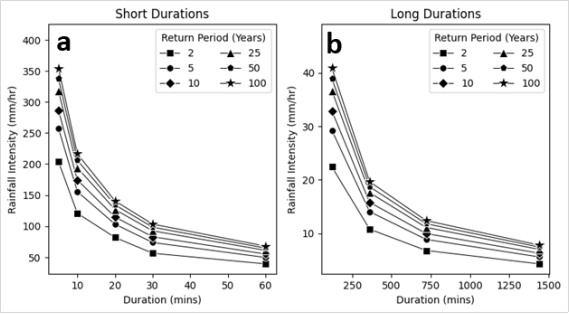
. This evidence of an increasing trend in rainfall in Umuahia provided sufficient evidence for developing rainfall models utilising a non-stationary approach. Table 5 presents the rainfall models developed using the non-stationary IDF approach. An analysis of the GEV parameters uncovers notable patterns across various time durations, ranging from 5 to 1440 minutes. For the 5-minute duration, the GEVt-I model provided the best fit, evidenced by the lowest AIC value of 196.264 and a BIC of 202.00. This trend of GEVt-I outperforming other models is consistent across all durations, as it repeatedly achieves the lowest AIC values. The models displayed similar behaviours for intermediate durations (10-60 minutes). In the analysis for 10 minutes, the GEVt-I model also performed optimally with an AIC of 212.487. This pattern continued for the 20-minute (AIC = 227.338) and the 30-minute (AIC = 236.338), where the location parameters adjusted gradually while preserving the model's superior fit. For longer durations (120-1440 minutes), GEVt-I remained the top performer, with the 720-minute duration analysis yielding an AIC of 302.018, and the 1440-minute duration presenting an AIC of 316.344, both reflecting the lowest values in their respective duration categories. The performance of the GEVt -I model suggests that the mean of the rainfall steadily increases over time, but there was little variation in the rainfall over time. The computed rainfall intensity utilising the non-stationary model is presented in Table 6. The non-stationary IDF curves is shown in Figure 4 which revealed similar trend with the stationary model. Increase in the duration would result in the reduction of the rainfall intensity for a particular return period. Also, increase in the return period would result to a more intense rainfall intensity for a particular duration.
Table 5. Evaluation of the performance of GEV parameters used for non-stationary and stationary models for Umuahia.
Time (mins)
Models
Location Parameter
Scale
Shape Parameter
BIC
AIC
5
GEVt– I
-181.219 + 0.097t
4.766
-0.204
202.00
196.264
GEVt– II
13.694
4.907 – 0.0001t
-0.231
205.06
199.319
GEVt- III
-241.848 + 0.127t
14.439– 0.005t
-0.204
204.94
197.766
10
GEVt– I
-63.339 + 0.040t
6.306
-0.222
218.222
212.487
GEVt– II
17.253
6.182 - 0.0002t
-0.231
219.386
213.650
GEVt- III
-188.624 + 0.103t
13.781– 0.004t
-0.210
220.125
212.955
20
GEVt– I
-31.406 + 0.027t
8.0489
-0.225
233.074
227.338
GEVt– II
21.737
7.787 + 0.0002t
-0.231
233.700
227.964
GEVt- III
-3.476+1.841t
2.028– 0.0006t
-0.218
233.623
226.453
30
GEVt– I
24.015 + 0.0004t
9.424
-0.230
242.075
236.338
GEVt– II
24.884
8.915 + 0.0002t
-0.231
242.082
236.347
GEVt- III
-63.906 + 0.044t
12.204– 0.002t
-0.236
244.682
237.512
60
GEVt– I
23.921 + 0.0037t
11.865
-0.233
256.343
250.607
GEVt– II
31.523
11.24 + 0.0003t
-0.231
256.404
250.668
GEVt- III
-487.80 + 0.259t
31.580– 0.010t
-0.211
256.38
249.214
120
GEVt– I
36.189 + 0.0017t
14.909
-0.232
270.707
264.971
GEVt– II
39.503
14.15 + 0.0004t
-0.231
270.729
264.993
GEVt- III
-53.978 + 0.047t
17.478 – 0.002t
-0.227
273.55
266.385
360
GEVt– I
56.024 + 0.0005t
21.489
-0.231
293.428
287.692
GEVt– II
56.978
20.41 + 0.0005t
-0.231
293.432
287.696
GEVt- III
-30.889 + 0.044t
23.496– 0.001t
-0.239
296.475
289.305
720
GEVt– I
70.603 + 0.0006t
27.078
-0.232
307.754
302.018
GEVt– II
71.787
25.71 + 0.0007t
-0.232
307.759
302.023
GEVt- III
20.065 + 0.0259t
27.47– 0.0003t
-0.231
311.005
303.835
1440
GEVt– I
88.962 + 0.0008t
34.120
-0.232
322.080
316.344
GEVt– II
90.478
32.39 + 0.0009t
-0.232
322.085
316.349
GEVt- III
88.902 + 0.008t
32.40 + 0.0009t
-0.232
325.514
318.344
Table 6. Computed rainfall intensity for the non-stationary model for Umuahia.
Figure 4. Non-Stationary IDF Curves for Shorter Durations (5-60 minutes) and for Longer Durations (120-1440 minutes).
3.3. General IDF Models
Table 7 summarizes the general IDF models developed for both stationary and non-stationary approaches. These models are based on the modified Sherman's equation format, which mathematically represents the relationship among rainfall intensity, duration, and return period. Both models exhibit impressive performance metrics. The stationary model attained a coefficient of determination (R²) of 0.998, suggesting it accounts for 99.8% of the variance in rainfall intensity. Its mean squared error (MSE) was 19.93, indicating strong prediction accuracy. Meanwhile, the non-stationary model produced a marginally lower R² of 0.992 and an MSE of 38.09, which is still notably high. These general models provide engineers and hydrologists with readily applicable equations for determining rainfall intensities for any duration and return period without referencing or interpolating from IDF curve graphs.
Table 7. GEV fitted General for Stationary and Non-stationary IDF (GNS-IDF) models for Umuahia.
S/N
Stations
IDF Models
R2
MSE
1
Stationary
I =
0.998
19.93
2
Non-Stationary
I =
0.992
38.09
3.4. Comparative Analysis of Rainfall Intensity Between Stationary and Non-Stationary Models
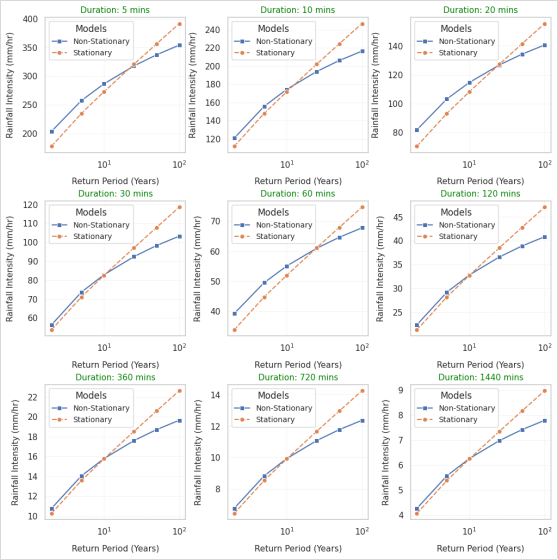
The rainfall intensity obtained from stationary and non-stationary models are presented in Figure 5. The result from Figure 5 revealed that the non-stationary model produces a higher rainfall intensity for the shorter return period (2 to 10 years). But for longer return periods, the stationary model produced higher rainfall intensity. The result of the percentage difference in the rainfall intensity for all durations and return periods is presented in Table 8. The percentage difference in the 2-year return period ranged from 4.93 - 16.16%, with the largest differences observed for 20 and 60 minutes. For the 5-year return period, differences ranged from 3.49 - 10.71%, and for the 10-year return period, from 0.16 - 5.93%.
Figure 5. Rainfall Intensity for Stationary and Non-Stationary models.

Table 8. Percentage Difference in Rainfall Intensity Between Non-Stationary and Stationary IDF Models for Umuahia.
Duration (mins)
Significant Trend
Significant Change Point
Return Period (Years)
2
5
10
25
50
100
5
Yes
Yes (2002-2003)
14.670
9.550
5.050
-0.950
-5.360
-9.610
10
Yes
Yes
(2002-2003)
7.960
5.220
1.490
-3.980
-8.180
-12.290
20
Yes
Yes
(2002-2003)
16.160
10.710
5.920
-0.420
-5.070
-9.530
30
Yes
Yes
(2002-2003)
4.930
3.620
0.330
-4.820
-8.890
-12.930
60
Yes
Yes
(2002-2003)
16.010
10.620
5.930
-0.290
-4.850
-9.230
120
Yes
Yes
(2002-2003)
5.000
3.550
0.200
-5.020
-9.120
-13.180
360
Yes
Yes
(2002-2003)
4.930
3.490
0.160
-5.040
-9.130
-13.180
720
Yes
Yes
(2002-2003)
4.930
3.500
0.160
-5.040
-9.140
-13.200
1440
Yes
Yes
(2002-2003)
4.940
3.500
0.160
-5.050
-9.150
-13.210
Average
-
-
8.840
5.970
2.150
-3.400
-7.650
-11.820
The pattern reversed for longer return periods (25-100 years), with stationary models generally predicting higher intensities than non-stationary models. At the 25-year return period, differences ranged from -0.29 to -5.05%. Differences were more pronounced for the 50-year return period, ranging from -4.85 to -9.15%. At the 100-year return period, the percentage differences ranged from -9.23 to -13.21%, indicating that stationary models may overestimate extreme rainfall events for very long return periods.
The average percentage differences across all durations were 8.84% for the 2-year return period, 5.97% for the 5-year return period, 2.15% for the 10-year return period, -3.40% for the 25-year return period, -7.65% for the 50-year return period, and -11.82% for the 100-year return period. This pattern of decreasing and eventually negative differences with increasing return period is consistent across all durations, suggesting a systematic relationship between the return period and the relative performance of stationary versus non-stationary models in Umuahia. The rainfall duration seems to exert a less consistent influence on the discrepancies between models compared to the return period. However, the 20 and 60-minute durations consistently demonstrate the most significant positive differences at shorter return periods, indicating this intermediate length (time interval) might be especially responsive to the non-stationary effects addressed by the time-dependent model.
4. Discussion
The comparative analysis of stationary and non-stationary IDF models reveals significant patterns that have important implications for infrastructure design and flood risk management in South-Eastern Nigeria. The finding from the result revealed that the non-stationary model predicted higher rainfall intensities for shorter return periods (2-10 years), indicating the need for developing IDF model adopting a non-stationary approach. Rainfall intensity at shorter durations and return periods is particularly useful for urban drainage design. A significant difference is highlighted at the 20-minute duration for the 2 and 5-year return periods, with non-stationary models predicting rainfall intensities of 16.16 and 10.71% greater than those from stationary models. This specific duration and return period range is critically important, representing the standard design criteria for residential and urban drainage systems. The findings suggest that Umuahia's existing drainage system, developed with a stationary rainfall model, might be significantly inadequate for current rainfall patterns, which could account for the rise in localised flooding observed in recent years.
The pattern of higher non-stationary intensities for frequent events and lower non-stationary intensities for rare events aligns with climate change projections that suggest an intensification of common rainfall events. Ganguli and Coulibaly observed that the rainfall intensity obtained from the non-stationary model was higher than the stationary one for most locations in Canada, especially for shorter return periods
[8]
Ganguli, P. & Coulibaly, P. (2017). Does non-stationarity in rainfall require non-stationary intensity-duration-frequency curves? Hydrology and Earth System Sciences, 21, 6461-6483.
[8]
. The percentage difference for shorter durations ranged from 1 to 14%, which was lower than the percentage difference obtained in the current study. Ganguli and Coulibaly argued that the lack of significant difference between the rainfall intensity obtained from the non-stationary and stationary models should not prompt the development of IDF relationships using a non-stationary approach
[8]
Ganguli, P. & Coulibaly, P. (2017). Does non-stationarity in rainfall require non-stationary intensity-duration-frequency curves? Hydrology and Earth System Sciences, 21, 6461-6483.
[8]
. However, this view can create problems, judging from the reasonable size percentage differences of 16% observed between stationary and non-stationary rainfall intensity for a design storm intensity of 20 minutes’ duration for a 2-year return period in the current study. Cheng & AghaKouchak also observed that the non-stationary model produced higher rainfall intensity, particularly for shorter return periods
[4]
Cheng, L. & AghaKouchak, A. (2014). Non-stationarity precipitation intensity-duration-frequency curves for infrastructure design in a changing climate. Science Reports, 4(7093), 1-6.
[4]
. They argued that the climate change projection or trend should dictate the use of non-stationary approach rather than the statistically significant difference observed between the rainfall intensity between the two approaches. Xu et al. reported that nonstationary models produced higher design storm intensity, DSI than stationary ones and attributed the higher DSI in nonstationary models to rapid urban development in the location
[21]
Xu, P., Wang, D., Wang, Y., Wu, J., Heng, Y., Singh, V. P.,... & Fang, H. (2024). Quantifying the urbanization and climate change-induced impact on changing patterns of rainfall Intensity-Duration-Frequency via nonstationary models. Urban Climate, 55, 101990. RetryClaude does not have internet access. Links provided may not be accurate or up to date.
[21]
.
From an engineering standpoint, these findings directly impact infrastructure design standards. Existing drainage systems, which are built for 2 to 10-year return periods using stationary assumptions, may be undersized by about 5 -16%. This shortcoming raises the likelihood of flooding during regular rainfall events. Thus, it is essential for engineering design standards to integrate non-stationary models, especially for infrastructure with shorter design return periods.
The findings indicate that climate change adaptation strategies in Umuahia must focus on enhancing urban drainage systems built for shorter return periods, as they demonstrate the most significant underestimation when applying stationary assumptions. Conversely, the existing stationary approaches yield more conservative estimates for major infrastructures meant to endure longer return periods (25-100 years). Identifying specific durations and return periods where differences are most pronounced provides valuable guidance for prioritising adaptation efforts in South-Eastern Nigeria.
5. Conclusion
The research investigated the difference between stationary and non-stationary rainfall IDF models in Umuahia, the capital of Abia state, Nigeria. The results indicate that the non-stationary model forecasted greater rainfall intensities for shorter return periods (2-10 years), highlighting the need for an IDF model employing a non-stationary approach. The rainfall intensity predictions for shorter durations and return periods are especially valuable for urban drainage design. The trend of higher non-stationary intensities for more frequent events (shorter return periods) gives an indication of a changing climate for more frequent hydrologic events. From an engineering perspective, these insights directly affect infrastructure design standards. Current drainage systems, which are designed for 2 to 10-year return periods based on stationary assumptions, could be insufficient by approximately 5-16%. This gap increases the risk of flooding during typical rainfall events. Therefore, it is important for engineering design standards to incorporate non-stationary models, particularly for infrastructures designed with shorter return periods.
Abbreviations
CDF
Cumulative Distribution Function
DSI
Design Storm Intensity
EVt
Extreme Value Type
GEV
General Extreme Value
GNS-IDF
General Non-stationary Intensity Duration Frequency
IDF
Intensity Duration Frequency
IMD
Indian Meteorological Department model
K-S
Kolmogorov-Smirnov
NIMET
Nigerian Meteorological Agency
NS-IDF
Non-stationary Intensity Duration Frequency
Author Contributions
Chimeme Martin Ekwueme: Conceptualization, Investigation, Methodology, Validation, Writing – original draft
Jonathan Onyekachi Irokwe: Funding acquisition, Writing – review & editing
Conflicts of Interest
The authors declare no conflicts of interest.
References
[1]
Abiodun, B. J., Adegoke, J., Abatan, A. A., Ibe, C. A., Egbebiyi, T. S., Engelbrecht, F. & Pinto, I. (2017). Potential impacts of climate change on extreme precipitation over four African coastal cities. Climate change (2017) 143: 399-413.
AghaKouchak, A., Ragno, E., Love, C. & Moftakhari, H. (2018). Projected Changes in California's precipitation intensity-duration-frequency curves. California's fourth climate change assessment, California energy commission. Pub. No.: CCCA4-CEC- 2018-005.
[3]
Akinsanola, A. A. & Ogunjobi, K. O. (2015). Recent homogeneity analysis and long-term spatio-temporal rainfall trends in Nigeria. Theoretical and Applied Climatology, 128, 275-289.
[4]
Cheng, L. & AghaKouchak, A. (2014). Non-stationarity precipitation intensity-duration-frequency curves for infrastructure design in a changing climate. Science Reports, 4(7093), 1-6.
[5]
Cheng, L., AghaKouchak, A., Gilleland, E. & Katz, R. W. (2014). Non-stationary extreme value analysis in a changing climate. Climate Change, 127(2), 353-369.
[6]
Coles, S., Bawa, J., Trenner, L. & Dorazio, P. (2001). An introduction to statistical modeling of extreme values. London: Springer.
[7]
Ekwueme, C. M., Nwaogazie, I. L., Ikebude, C. F., Amuchi, G. O., Irokwe, J. O., et al. (2025). Modeling Rainfall Intensity-Duration-Frequency (IDF) and Establishing Climate Change Existence in Umuahia - Nigeria Using Non-Stationary Approach. Hydrology, 13(1), 83-89.
Ganguli, P. & Coulibaly, P. (2017). Does non-stationarity in rainfall require non-stationary intensity-duration-frequency curves? Hydrology and Earth System Sciences, 21, 6461-6483.
[9]
Katz, R. W. (2013). Statistical methods for nonstationary extremes. In: Extremes in a changing climate (pp. 15-37). Dordrecht: Springer.
[10]
Masi, M., Kanakoudis, V., & Salcedo, A. G. (2023). Statistical, Analytical and Numerical Approaches for the Design of Urban Drainage Systems under Climate Change Conditions. Climate, 11(7), 141.
Milly, P. C. D., Betancourt, J., Falkenmark, M., Hirsch, R. M., Kundzewicz, Z. W., Lettenmaier, D. P. & Stouffer, R. J. (2008). Stationarity is dead: Whither water management? Science, 319(5863), 573-574.
Nwaogazie, I. L., Sam, M. G., Enciso, R. Z., & Gonsalves, E. (2019). Probability and non-probability rainfall intensity-duration-frequency modeling for Port-Harcourt metropolis, Nigeria. International Journal of Hydrology, 3(1), 66-75.
[13]
Odjugo, P. A. O. (2013). Analysis of climate change awareness in Nigeria. Science Research Essays, 8(26), 1203-1211.
[14]
Ouarda, T. B. M. J., Yousef, L. A. & Charron, C. (2019). Non-stationary intensity-duration-frequency curves integrating information concerning teleconnections and climate change. International Journal of Climatology, 39, 2306-2323.
Sam M. G, Nwaogazie I. L. and Ikebude, C. (2021): Improving Indian meteorological department method for 24- hourly rainfall downscaling to shorter durations for IDF modelling. International Journal of Hydrology; 5(2): 72-82.
Sam, M. G., Nwaogazie, I. L., Ikebude, C., Inyang, U. J. and Irokwe, J. O. (2023a). Modeling Rainfall Intensity-Duration-Frequency (IDF) and Establishing Climate Change Existence in Uyo-Nigeria Using Non-Stationary Approach. Journal of water Resource and protection, Vol. 15, pp 194-214.
[17]
Sam, M. G., Nwaogazie, I. L., & Ikebude, C. (2023b). Establishing Climatic Change on Rainfall Trend, Variation and Change Point Pattern in Benin City, Nigeria. International Journal of Environment and Climate Change, 13(5), 202-212.
[18]
Sam, M. G., Nwaogazie, I. L., & Ikebude, C. (2023c). General extreme value fitted rainfall non-stationary intensity-duration-frequency (NS-IDF) modelling for establishing climate change in Benin City. Hydrology, 11(4), 85-93.
[19]
Silva, D. F. & Simonovic, S. P. (2020). Development of non-stationary rainfall intensity duration frequency curves for future climate conditions. Water resources research report No: 106. Department of civil and environmental engineering, western University, Canada.
[20]
Te Chow, V., Maidment, D. R., & Mays, L. W. (1988). Solutions Manual to Accompany Applied Hydrology. McGraw-Hill.
[21]
Xu, P., Wang, D., Wang, Y., Wu, J., Heng, Y., Singh, V. P.,... & Fang, H. (2024). Quantifying the urbanization and climate change-induced impact on changing patterns of rainfall Intensity-Duration-Frequency via nonstationary models. Urban Climate, 55, 101990. RetryClaude does not have internet access. Links provided may not be accurate or up to date.
Ekwueme, C. M., Nwaogazie, I. L., Ikebude, C. F., Amuchi, G. O., Irokwe, J. O. (2025). Comparative Analyses of Stationary and Non-Stationary IDF Rainfall Models for Umuahia. Hydrology, 13(2), 102-113. https://doi.org/10.11648/j.hyd.20251302.12
Ekwueme, C. M.; Nwaogazie, I. L.; Ikebude, C. F.; Amuchi, G. O.; Irokwe, J. O. Comparative Analyses of Stationary and Non-Stationary IDF Rainfall Models for Umuahia. Hydrology. 2025, 13(2), 102-113. doi: 10.11648/j.hyd.20251302.12
Ekwueme CM, Nwaogazie IL, Ikebude CF, Amuchi GO, Irokwe JO. Comparative Analyses of Stationary and Non-Stationary IDF Rainfall Models for Umuahia. Hydrology. 2025;13(2):102-113. doi: 10.11648/j.hyd.20251302.12
@article{10.11648/j.hyd.20251302.12,
author = {Chimeme Martin Ekwueme and Ify Lawrence Nwaogazie and Chiedozie Francis Ikebude and Godwin Otunyo Amuchi and Jonathan Onyekachi Irokwe},
title = {Comparative Analyses of Stationary and Non-Stationary IDF Rainfall Models for Umuahia
},
journal = {Hydrology},
volume = {13},
number = {2},
pages = {102-113},
doi = {10.11648/j.hyd.20251302.12},
url = {https://doi.org/10.11648/j.hyd.20251302.12},
eprint = {https://article.sciencepublishinggroup.com/pdf/10.11648.j.hyd.20251302.12},
abstract = {This study aimed to develop IDF models and compare rainfall intensity obtained from the stationary and non-stationary IDF models for Umuahia in South-Eastern Nigeria. The research used a long-term rainfall dataset spanning three decades (1992-2022) sourced from the Nigerian Meteorological Agency. The daily rainfall data recorded over 24 hours was downscaled to shorter periods using the Indian Meteorological Department model (IMD). For determining the best distribution fitting for the rainfall data, the Kolmogorov-Smirnov (K-S) test was utilised. The result from the K-S test revealed that Gumbel EVT-1 was the best-fitting distribution for creating the stationary IDF models. The GEVt-I model, which includes a time-dependent location parameter, proved the most effective for non-stationary models. The comparative analysis showed that non-stationary models forecasted greater rainfall intensities for shorter return periods (2-10 years), with variations between 4.93 and 16.16% for the 2-year return period. In contrast, for longer return periods (25-100 years), stationary models yielded higher intensity predictions, with differences ranging from -0.29 -13.21%. These results have important implications for infrastructure design and flood risk management in Umuahia, indicating that existing drainage systems based on stationary assumptions may be undersized by 5-16%, which could elevate the risk of flooding during typical rainfall events.
},
year = {2025}
}
TY - JOUR
T1 - Comparative Analyses of Stationary and Non-Stationary IDF Rainfall Models for Umuahia
AU - Chimeme Martin Ekwueme
AU - Ify Lawrence Nwaogazie
AU - Chiedozie Francis Ikebude
AU - Godwin Otunyo Amuchi
AU - Jonathan Onyekachi Irokwe
Y1 - 2025/04/29
PY - 2025
N1 - https://doi.org/10.11648/j.hyd.20251302.12
DO - 10.11648/j.hyd.20251302.12
T2 - Hydrology
JF - Hydrology
JO - Hydrology
SP - 102
EP - 113
PB - Science Publishing Group
SN - 2330-7617
UR - https://doi.org/10.11648/j.hyd.20251302.12
AB - This study aimed to develop IDF models and compare rainfall intensity obtained from the stationary and non-stationary IDF models for Umuahia in South-Eastern Nigeria. The research used a long-term rainfall dataset spanning three decades (1992-2022) sourced from the Nigerian Meteorological Agency. The daily rainfall data recorded over 24 hours was downscaled to shorter periods using the Indian Meteorological Department model (IMD). For determining the best distribution fitting for the rainfall data, the Kolmogorov-Smirnov (K-S) test was utilised. The result from the K-S test revealed that Gumbel EVT-1 was the best-fitting distribution for creating the stationary IDF models. The GEVt-I model, which includes a time-dependent location parameter, proved the most effective for non-stationary models. The comparative analysis showed that non-stationary models forecasted greater rainfall intensities for shorter return periods (2-10 years), with variations between 4.93 and 16.16% for the 2-year return period. In contrast, for longer return periods (25-100 years), stationary models yielded higher intensity predictions, with differences ranging from -0.29 -13.21%. These results have important implications for infrastructure design and flood risk management in Umuahia, indicating that existing drainage systems based on stationary assumptions may be undersized by 5-16%, which could elevate the risk of flooding during typical rainfall events.
VL - 13
IS - 2
ER -
Ekwueme, C. M., Nwaogazie, I. L., Ikebude, C. F., Amuchi, G. O., Irokwe, J. O. (2025). Comparative Analyses of Stationary and Non-Stationary IDF Rainfall Models for Umuahia. Hydrology, 13(2), 102-113. https://doi.org/10.11648/j.hyd.20251302.12
Ekwueme, C. M.; Nwaogazie, I. L.; Ikebude, C. F.; Amuchi, G. O.; Irokwe, J. O. Comparative Analyses of Stationary and Non-Stationary IDF Rainfall Models for Umuahia. Hydrology. 2025, 13(2), 102-113. doi: 10.11648/j.hyd.20251302.12
Ekwueme CM, Nwaogazie IL, Ikebude CF, Amuchi GO, Irokwe JO. Comparative Analyses of Stationary and Non-Stationary IDF Rainfall Models for Umuahia. Hydrology. 2025;13(2):102-113. doi: 10.11648/j.hyd.20251302.12
@article{10.11648/j.hyd.20251302.12,
author = {Chimeme Martin Ekwueme and Ify Lawrence Nwaogazie and Chiedozie Francis Ikebude and Godwin Otunyo Amuchi and Jonathan Onyekachi Irokwe},
title = {Comparative Analyses of Stationary and Non-Stationary IDF Rainfall Models for Umuahia
},
journal = {Hydrology},
volume = {13},
number = {2},
pages = {102-113},
doi = {10.11648/j.hyd.20251302.12},
url = {https://doi.org/10.11648/j.hyd.20251302.12},
eprint = {https://article.sciencepublishinggroup.com/pdf/10.11648.j.hyd.20251302.12},
abstract = {This study aimed to develop IDF models and compare rainfall intensity obtained from the stationary and non-stationary IDF models for Umuahia in South-Eastern Nigeria. The research used a long-term rainfall dataset spanning three decades (1992-2022) sourced from the Nigerian Meteorological Agency. The daily rainfall data recorded over 24 hours was downscaled to shorter periods using the Indian Meteorological Department model (IMD). For determining the best distribution fitting for the rainfall data, the Kolmogorov-Smirnov (K-S) test was utilised. The result from the K-S test revealed that Gumbel EVT-1 was the best-fitting distribution for creating the stationary IDF models. The GEVt-I model, which includes a time-dependent location parameter, proved the most effective for non-stationary models. The comparative analysis showed that non-stationary models forecasted greater rainfall intensities for shorter return periods (2-10 years), with variations between 4.93 and 16.16% for the 2-year return period. In contrast, for longer return periods (25-100 years), stationary models yielded higher intensity predictions, with differences ranging from -0.29 -13.21%. These results have important implications for infrastructure design and flood risk management in Umuahia, indicating that existing drainage systems based on stationary assumptions may be undersized by 5-16%, which could elevate the risk of flooding during typical rainfall events.
},
year = {2025}
}
TY - JOUR
T1 - Comparative Analyses of Stationary and Non-Stationary IDF Rainfall Models for Umuahia
AU - Chimeme Martin Ekwueme
AU - Ify Lawrence Nwaogazie
AU - Chiedozie Francis Ikebude
AU - Godwin Otunyo Amuchi
AU - Jonathan Onyekachi Irokwe
Y1 - 2025/04/29
PY - 2025
N1 - https://doi.org/10.11648/j.hyd.20251302.12
DO - 10.11648/j.hyd.20251302.12
T2 - Hydrology
JF - Hydrology
JO - Hydrology
SP - 102
EP - 113
PB - Science Publishing Group
SN - 2330-7617
UR - https://doi.org/10.11648/j.hyd.20251302.12
AB - This study aimed to develop IDF models and compare rainfall intensity obtained from the stationary and non-stationary IDF models for Umuahia in South-Eastern Nigeria. The research used a long-term rainfall dataset spanning three decades (1992-2022) sourced from the Nigerian Meteorological Agency. The daily rainfall data recorded over 24 hours was downscaled to shorter periods using the Indian Meteorological Department model (IMD). For determining the best distribution fitting for the rainfall data, the Kolmogorov-Smirnov (K-S) test was utilised. The result from the K-S test revealed that Gumbel EVT-1 was the best-fitting distribution for creating the stationary IDF models. The GEVt-I model, which includes a time-dependent location parameter, proved the most effective for non-stationary models. The comparative analysis showed that non-stationary models forecasted greater rainfall intensities for shorter return periods (2-10 years), with variations between 4.93 and 16.16% for the 2-year return period. In contrast, for longer return periods (25-100 years), stationary models yielded higher intensity predictions, with differences ranging from -0.29 -13.21%. These results have important implications for infrastructure design and flood risk management in Umuahia, indicating that existing drainage systems based on stationary assumptions may be undersized by 5-16%, which could elevate the risk of flooding during typical rainfall events.
VL - 13
IS - 2
ER -